
 Войти
Войти
 Новости
 Погода
 Магнитные бури
 Время намаза
 Драгоценные металлы
 Конвертор валют
 Кредитный калькулятор
 Курс криптовалют
 Гороскоп
 Вопрос - Ответ
 Проверьте скорость интернета
 Радио Казахстана
 Казахстанское телевидение
 О нас
О нас




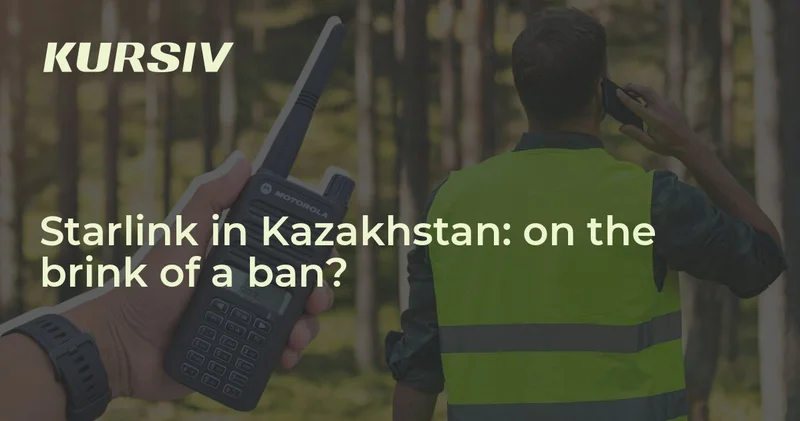
Starlink in Kazakhstan: on the brink of a ban?
Qazaq24.com, ссылаясь на сайт Kursiv.Media, передает.
 Why Kazakhstan is hesitating on a Starlink ban / Collage: Kursiv.media, photo editor: Milosh Muratovskiy
Kazakhstan’s recent proposal to ban the import of several satellite communication devices — including those from major manufacturers such as Thuraya, Iridium, Inmarsat and Starlink — has sparked widespread debate. Many commentators have spoken out against the proposal, prompting its initiators to backtrack.
The logic behind the proposed ban
On Dec. 6, 2024, Kazakhstan’s Ministry of Digital Development published a draft order on the Legalacts.egov.kz portal, proposing new regulations on the import of certain telecommunications equipment with control centers located outside the country.
The proposed regulation targets satellite phones and stations used for communication in remote areas by rescue teams, emergency response units, the navy, travelers and others operating far from urban infrastructure.
Citing national security concerns, the draft order specifically named four companies whose devices would be restricted: Starlink (developed by Elon Musk’s SpaceX), Inmarsat, Iridium and Thuraya.
The legal basis for such a ban comes from Article 23 of Kazakhstan’s National Security Law, adopted in 2012, which prohibits the establishment and operation of communication networks within Kazakhstan if their control centers are based outside the country. The recent draft order sought to expand the list of prohibited devices and require that the control centers for these systems be located within Kazakhstan.
However, the proposal quickly stirred controversy and was withdrawn. It is now under review by several government agencies, including the Ministry of National Economy, the Ministry of Finance, the Ministry of Trade, the Ministry of Digital Development and the National Security Committee. The interagency task force will have to revise the initial draft.
Can Starlink be replaced by other systems?
Alexey Korchagin, commercial director of Zharyq LLP — the official partner of Inmarsat, Starlink, Thuraya and Iridium in Kazakhstan — expressed shock at the publication of the draft order.
«Considering how vital satellite equipment is to Kazakhstan’s security, and with thousands of grateful testimonials from people whose lives were saved by our satellite phones, it’s hard to imagine rejecting such essential emergency communication tools,» Korchagin said.
However, the Ministry of Digital Development believes there are viable alternatives to the soon-to-be-banned devices, some of which are already in operation in Kazakhstan.
«The Eutelsat-OneWeb operator meets national security requirements and provides communication services via non-geostationary satellites,» the ministry stated. «A memorandum has also been signed with Amazon Kuiper, and favorable agreements have been reached with Shanghai Spacecom Satellite Technology Co. Ltd.»
Korchagin argues that these alternatives cannot fully replace Thuraya, Inmarsat and Iridium because they serve different purposes.
«Very Small Aperture Terminal (VSAT) satellite systems — such as those operating on KazSat-2, KazSat-3 and the OneWeb non-geostationary satellite network — cannot replace mobile satellite solutions. These are not satellite phones; they are technologies designed for broadband data transmission,» he explained. «VSAT and OneWeb terminals are used in entirely different applications. They range in weight from several kilograms to dozens, require professional setup and cannot be compared to satellite phones, which fit in your pocket and enable communication from remote areas.»
According to Korchagin, mobile satellite devices are compact, weighing as little as 200 grams, and are primarily designed for voice communication.
«They are easy to use, require no special skills and are used across various industries. Comparing a small satellite phone to a bulky satellite terminal — which requires an external power source or, for mobile use, a battery — is impractical,» he said.
Experts weigh in on the satellite phone ban

In response to an inquiry from Kursiv.media, the Ministry of Digital Development stated that the ban is necessary to protect the data of citizens and government agencies from potential cybersecurity threats.
«The National Security Committee (KNB) has identified 31 electronic devices with control centers located outside Kazakhstan, claiming they could pose a data security threat since they are operated from abroad,» the ministry noted.
Yelzhan Kabyshev, a lawyer specializing in digital rights, views the proposed ban as an effort to tighten control over the flow of information within Kazakhstan.
«The government justifies these bans in the name of national security. However, in many cases, it’s really about controlling information. Just look at past measures introduced by the authorities: security certificates, internet shutdowns and Man-in-the-Middle (MITM) attacks, where an intermediary intercepts communications between two parties. All of these were also framed as national security measures,» Kabyshev explained. «In reality, these tools end up in the hands of law enforcement agencies, who can use them for both good and harm. As for the KNB, it’s hard to predict how they will act. I have little trust in them, especially considering that nearly the entire leadership of the committee was prosecuted following the January 2022 events.»
Korchagin of Zharyq LLP also questions whether the potential security risk justifies an outright ban on satellite phones.
«Satellite communications can certainly be used by bad actors, but that’s not a valid reason for a ban. If someone really wants a satellite phone, they’ll simply import it illegally,» he argued.
Can satellite communications be banned?
Korchagin highlighted that the devices targeted by the draft regulation are essential, if not the only, means of ensuring safety for many people in Kazakhstan.
«It’s hard to predict the full scope of the negative consequences this ban could have, as there has never been a precedent for such a move, except in a few isolated countries. A complete rejection of mobile satellite technologies like Iridium, Inmarsat and Thuraya would be unprecedented. Satellite communication is internationally recognized by organizations such as the International Telecommunication Union (ITU) and the International Maritime Organization (IMO),» he said.
Despite the potential ban, Korchagin believes these devices will still find their way into Kazakhstan through alternative channels, bypassing the restrictions.
«There’s always someone ready to fill the gap. This ban will create opportunities for the growth of a ‘gray’ market for unregistered devices and SIM cards in Kazakhstan. In the short term, it will also lead to a gradual depletion of the existing stock of satellite devices, as wear and tear over time will eventually render them unusable,» Korchagin warned.
As an alternative to the ban, he suggested that the government work more closely with satellite operators instead of imposing outright restrictions.
What will happen to internet access in Kazakhstan’s rural schools?
Since 2023, the cabinet has been working to expand internet access in areas where connectivity is weak or nonexistent. As part of this initiative, the Ministry of Digital Development launched a pilot project to connect nearly 2,000 rural schools to Starlink satellite internet by July 2024. The ministry has assured the public that the ban on satellite phones will not impact the devices used in the pilot project. However, the project is set to continue until Jan. 1, 2026, and its long-term future remains uncertain.
 Другие новости на эту тему:
 Просмотров:275
 Эта новость заархивирована с источника 11 Октября 2025 14:23






 Самые читаемые