
 Войти
Войти
 Новости
 Погода
 Магнитные бури
 Время намаза
 Драгоценные металлы
 Конвертор валют
 Кредитный калькулятор
 Курс криптовалют
 Гороскоп
 Вопрос - Ответ
 Проверьте скорость интернета
 Радио Казахстана
 Казахстанское телевидение
 О нас
О нас



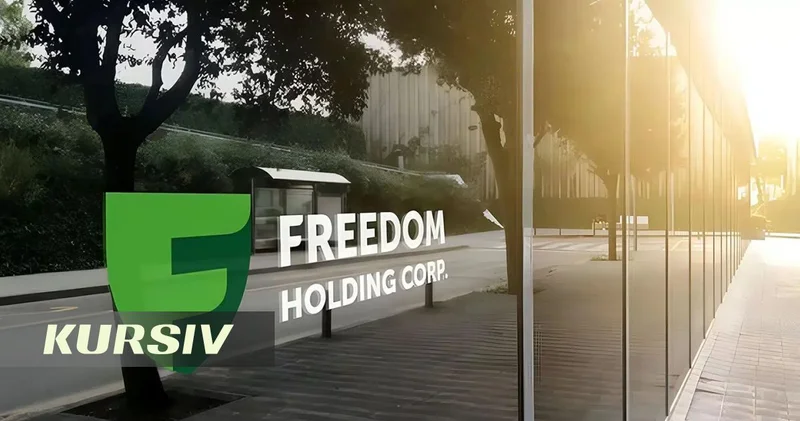
Freedom Holding outlines plan to build service ecosystem
По данным сайта Kursiv.Media, передает Qazaq24.com.
 Photo: Freedom Finance
Freedom Holding Corp. (FRHC) aims to create a fully-fledged digital infrastructure in Kazakhstan that contributes to the country’s development, according to the company’s CEO Timur Turlov. He made this statement at the FRHC Strategic Summit held from Jan. 25 to Jan. 29 in Limassol, Cyprus.
Global scaleThe Freedom Holding Corp. ecosystem includes Freedom Broker, Freedom Bank Kazakhstan, Freedom Finance Europe, as well as insurance, technology and lifestyle companies.
Freedom Holding Corp. recently released its financial statement for the third quarter of fiscal year 2026 (ended Dec. 31, 2025), reporting nearly $1.7 billion in revenue for the first nine months of the year. Net income for the period was approximately $145 million, with earnings per share (EPS) at $2.43. These figures reflect the company’s resilience and its ability to maintain profitability even as it scales.
Total assets of the holding have reached $12.4 billion, with equity valued at approximately $1.4 billion. Its cash, cash equivalents and investable assets amounted to approximately $6.6 billion, ensuring a significant financial buffer for FRHC. Operating activities generate substantial cash flow, giving the company flexibility for long-term investment and growth.
FRHC’s scale is particularly evident in its client base. Freedom serves more than 7.2 million clients across all its business lines, or over 11 million unique customers when related businesses are included. These include 4.5 million banking clients, approximately 1.2 million insurance clients and 828,000 brokerage accounts. The number of users of digital and ecosystem services, including SuperApp, has reached nearly 4 million, reflecting Freedom’s presence in its clients’ everyday financial lives.
Freedom Holding Corp. operates in 21 countries. The company’s shares are traded on the Nasdaq and are included in the Russell 3000 Index and Motley Fool’s Moneyball portfolio. All of this demonstrates the company’s strong position in international capital markets. As of the end of 2025, the holding’s market capitalization was estimated at $10 billion.
This scale changes the very logic of a company’s development. When a business achieves billions in revenue, a multibillion-dollar balance sheet and a massive customer base, the key task is no longer the growth of individual services, but the management of the system as a whole. Sustainability, architecture and the company’s role in the national economy become the most important conditions for continued growth.
In this context, the summit marked the transition to a new strategic framework outlined by Timur Turlov: shifting from a set of products to a digital service infrastructure in Kazakhstan for further export to other countries.
Three areas of changeAccording to Turlov, the company uses its strategy to align its understanding of ongoing changes.
«Strategy is always a response to the reality we find ourselves in. It emerges not on a schedule, but when old answers essentially cease to work,» he said in his address to the board of directors.
As the FRHC CEO noted, the company has reached a qualitatively different stage of growth in recent years, which requires a new level of understanding.
«We have ceased to be a collection of individual companies and have become an ecosystem,» he emphasized.
Addressing board members at the Strategic Summit, Timur Turlov described the context in which the holding company is developing. He identified three areas of change: the company, the market and the country.
Speaking about internal development, Turlov noted that rapid growth inevitably leads to more complex management. «As a company, we have been growing rapidly, which is why it is objectively difficult to avoid signs of growing pains,» he said, underscoring that the next stage involves improving the manageability and sustainability of the ecosystem.
Regarding the market, he pointed out that in some segments, development is increasingly being replaced by competition among functions. «Some companies in the market have reached a visible limit, and much is turning not into development, but into a service race.»
According to Turlov, Freedom’s goal must be different:
«We don’t plan to get involved in this race. We have always been and will remain trendsetters.»
The third area of change for the holding, which operates in dozens of countries, is Kazakhstan. «The government has dived deep into large-scale digitalization and, in parallel, has embarked on profound institutional reforms,» the CEO said, emphasizing that these processes are shaping the long-term context for business.
Kazakhstan, where the holding’s current model was shaped, took a central role during Turlov’s speech at the Strategic Summit.
«Advanced American business practices are part of Freedom Holding’s DNA and they are what have largely made us who we are today. But at the same time, we are embedded in the realities of the country where we are building our core business. Moreover, there is no doubt for me that without Kazakhstan, without the conditions our country has provided, Freedom, as it is today, would not have been possible.»

Timur Turlov’s key message to his 17,000-strong team is this: stop thinking in terms of individual products and start thinking about creating institutions and an environment of trust that will make business more sustainable and make Kazakhstan richer.
Business as infrastructureFreedom is moving from the logic of individual services to an infrastructure-based model.
«We are not a showcase. Our logic is infrastructure-based. Crucial parts of our DNA are fintech and the ability to create an environment of trust, not just arranging products on a shelf,» Timur Turlov said during the Cyprus Summit. «Either Freedom remains a portfolio of services constantly racing against the market and each other, or it becomes a fully-fledged digital infrastructure that contributes to the development of society and the country.»
As Turlov noted, it was the creation of infrastructure and the development of culture that once allowed the company to grow alongside the market. Now, this principle has been enshrined as the strategic foundation of the holding’s next stage of development.
Global contextAlthough Freedom Holding Corp. current model is unique to Kazakhstan and Central Asia, it aligns closely with several global trends that have emerged in the digital economy and fintech sector. There are at least four such trends.
The first is the transition from individual services to digital infrastructure. In many countries, fintech has long been divided into two levels. The first consists of products familiar to users: applications, services and functions. The second encompasses core infrastructure such as payment systems, customer identification and risk management. This second level is considered more resilient because it is embedded in the economy and continues to operate regardless of the popularity of specific products.
The second trend is the development of embedded finance, in which financial services are integrated into non-financial contexts. Financial services are no longer about «visiting a bank.» Instead, they appear when people pay for services, shopping, transportation, education or housing on a daily basis. This shift is reflected in a World Bank study, which views digital transformation as a key driver of change in the financial system.
The third trend is the evolution of superapps. This is not about an application that offers everything; it is about a single digital gateway to an ecosystem. This gateway becomes a unified interface through which users regularly interact with services, while companies gain data, engagement frequency and the ability to build long-term relationships. In this model, finance serves not as window dressing, but as a connecting element. China’s WeChat and Alipay, for example, have built trust, accounting and scoring infrastructures around their own services.
The fourth trend is digital public infrastructure. This refers to digital systems that establish basic rules of interaction in society, including accounting, transparency, trust, payments and identity verification. In some countries, such systems are built by governments, while in others they are created in partnership with private businesses. This platform logic is evident in GovTech Singapore, which provides digital government services. Another well-known example of public-private collaboration is Palantir, which is integrated into institutional and government processes by providing infrastructure analytics systems for governments and corporations.
«Digital public infrastructure is an approach to digitalization focused on creating foundational digital building blocks designed for the public benefit,» the World Bank said in its report on digital public infrastructure.
Freedom’s current transformation is rooted in the logic of these trends. The company is moving from a collection of digital products and services to an infrastructure model in which finance, data and everyday digital services are integrated into a single ecosystem. The value of this system is determined by fundamental institutions such as government and society rather than by individual target audiences. In this model, trust becomes the primary metric of success.
The transformation of the Freedom ecosystem is not an attempt to copy existing models, but a response to a global shift and national demand: a move away from competing functions toward creating sustainable digital foundations for economic and social interaction.
«The transition to an infrastructure role always carries new risks, from regulatory burdens to responsibility for system stability. The balance between scale, control and trust will be the key challenge of the next stage,» Timur Turlov underlined.
 Другие новости на эту тему:
 Просмотров:191
 Эта новость заархивирована с источника 11 Февраля 2026 10:11






 Самые читаемые